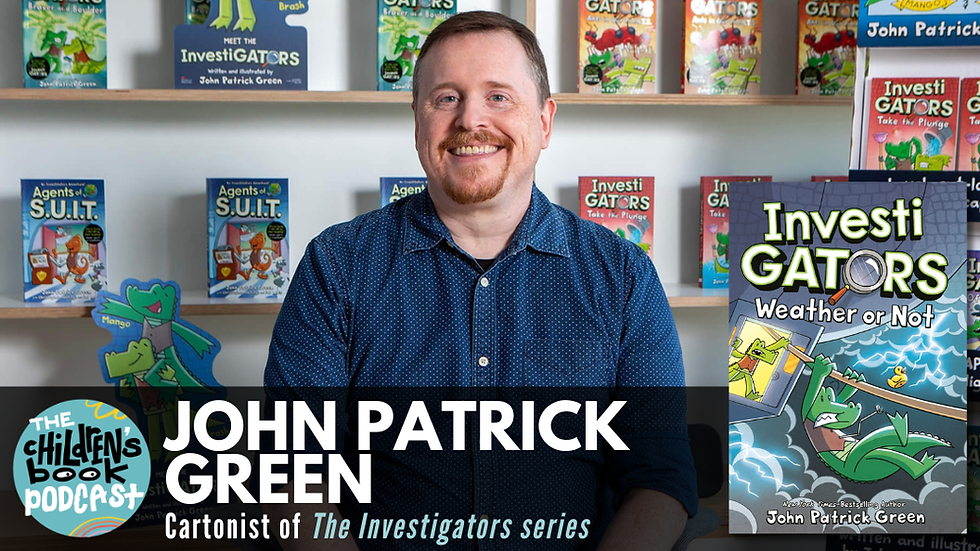
Do It Together with Julie Fiveash


Julie Fiveash, cartoonist of The Froggy Library: Welcome to Soggy Stump (Levine Querido), with colors by Jess Lome, joins Matthew to talk about getting over the challenge of a new project pretending that you know enough about what you’re doing.
Listen along:
About the book: The Froggy Library: Welcome to Soggy Stump by Julie Fiveash; Colors by Jess Lome. Published by Levine Querido.
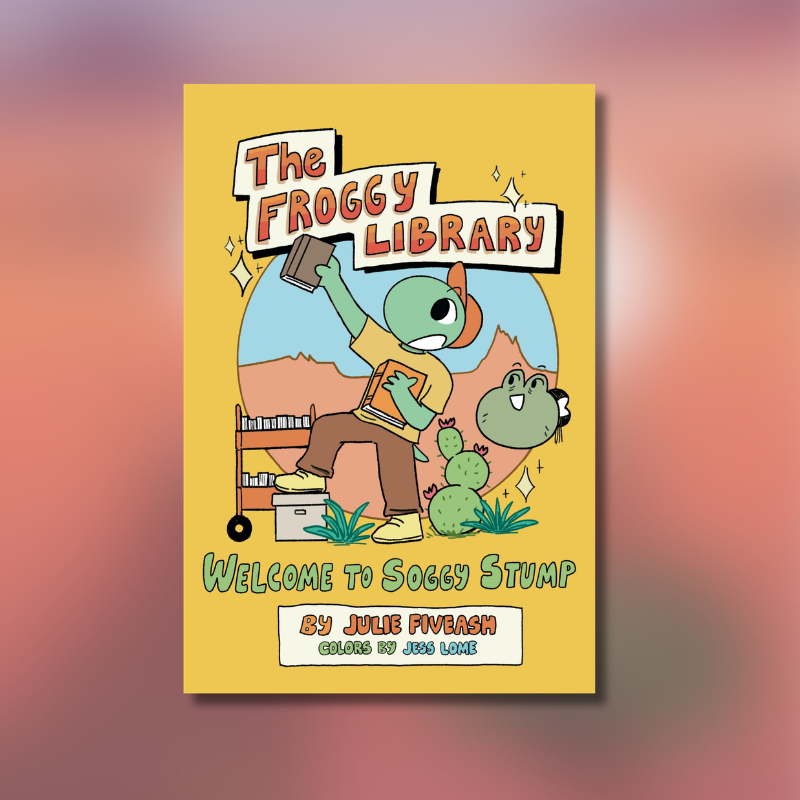
Spend your summer on Soggy Stump! This cozy, colorful, and amphibious graphic novel adventure draws inspiration from the author's background as a Diné librarian.
Anura is a young frog spending the summer back home with their grandmother. With some...er...gentle prodding from Grandma, they get a job working at the local library. It's about 11 minutes in when they're tasked with a big project: create an archive that captures what makes Soggy Stump so special.
What the heck is even an archive?! And so begins a summer full of fry bread, weaving, zines, community gardens, manga, and (maybe) an answer to the question of: how do we preserve the knowledge, wisdom, and memories of the ones we love?
Inspired by Julie Fiveash's Diné background and career as a librarian, and infused throughout with the colors of the Southwest, The Froggy Library is a love letter to Native communities, summers with friends and family, and libraries everywhere.
More:
Visit Julie Fiveash online at www.instagram.com/jooliefiveash
Visit the Barnard Zine Library at https://zines.barnard.edu
Learn more about Boyds Mills and their upcoming programs by visiting www.boydsmills.org.
Transcript:
NOTE: Transcript created by Descript. I've attempted to clean up any typos, grammatical errors, and formatting errors where possible.
Julie: People feel isolated and on an island so often now, I think, by just virtue of being online and being by yourself in a room looking at your phone. And I think we forget a lot about the community that we have around us, and wanna reinforce that.
Matthew: That is the voice of Julie Fiveash, the cartoonist behind The Froggy Library: Welcome to Soggy Stump (Levine Querido), with colors by Jess Lome.
Welcome back to the Children’s Book Podcast, where we celebrate the books and creators who help young readers feel seen, supported, and understood. This episode is brought to you in partnership with Boyds Mills, positively impacting kids by amplifying the voices of storytellers who inspire children to become their best selves.
I’m your host, Matthew Winner—teacher, librarian, writer, and a fan of kids.
A Native librarian making a graphic novel about frogs who are Native and setting up an archive in their library?! Um… yes please!
Here are a few of the things I learned in this conversation:
NUMBER ONE: Archival work! I am a school librarian by trade. We don’t do a ton of archival work, as it happens. Julie makes the process feel electric and important and communal, which it is! This is a world I hope they are able to continue to build out because I am already such a big fan of theirs!
NUMBER TWO: Julie introduced me to the phrase DIT (Do It Together). We throw around DIY like it’s nothing, but DIT has got some serious weight behind it and Julie makes sure to emphasize that together is how Anura and the community will make an archive that will be valued by all.
And NUMBER THREE: The Barnard Zine Library! I honestly had no idea this existed and now it’s all I can think about! I’ll be sure to have a link in the show notes in case you want to browse, too.
So, a little about The Froggy Library: Welcome to Soggy Stump (Levine Querido) from the publisher:
“Spend your summer on Soggy Stump! This cozy, colorful, and amphibious graphic novel adventure draws inspiration from the author's background as a Diné librarian.
Anura is a young frog spending the summer back home with their grandmother. With some...er...gentle prodding from Grandma, they get a job working at the local library. It's about 11 minutes in when they're tasked with a big project: create an archive that captures what makes Soggy Stump so special.
What the heck is even an archive?! And so begins a summer full of fry bread, weaving, zines, community gardens, manga, and (maybe) an answer to the question of: how do we preserve the knowledge, wisdom, and memories of the ones we love?
Inspired by Julie Fiveash's Diné background and career as a librarian, and infused throughout with the colors of the Southwest, The Froggy Library is a love letter to Native communities, summers with friends and family, and libraries everywhere.”
Time to enter that glittering world together!
Please welcome Julie Fiveash to the podcast.
Julie: My name is Julie Fiveash. I am Dine Navajo. I am a s- librarian, I'm a [00:01:00] zinester and I'm a cartoonist, and I'm the author of The Froggy Library: Welcome to Soggy Stump.
Matthew: Yes. Thank you for being here, Julie. I... How often do you ever get to talk to a cartoonist about library stuff because they also are a librarian?
Giddy hardly describes m- the energy you're getting me on today. I'm so glad you're here, and before we go any further, I just wanna tell you that I loved your book. It was beautiful. I thought I could picture the readers for it immediately, and also it was something that I really delighted in connecting with.
So well done, you. Thank you. I've had so many people tell me... I wasn't expecting so many people to have a connection with it. I don't know. I just write things and I put it out there, and I'm instantly surprised when people find something in it that is meaningful to them, and it delights me and I'm just, yeah, I'm always very happy that somebody found something in there that [00:02:00] they liked.
That is so cool. It's so cool to make a thing because you like it and feel a connection, an unexpected sometimes connection- ... with somebody else because they like it as well. That's a cool thing. Before we go any further, do you mind sharing a brief book talk of The Froggy Library: Welcome to Soggy Stump f- for folks that m- don't know the book yet or haven't encountered it yet?
Julie: Yeah. So it's a graphic novel. It is about a young frog named Honoré who goes to spend the summer with their grandmother in a place called Soggy Stump. It's all relatively loosely, like ... the frogs are a a metaphor stand-in for Navajo folks. So all the frogs are Native.
And they... The main character, Honoré gets a job at their local library to start a community archive. So they have to go and learn things about the community that they're in. And it's not one that they're usually in, so they have a l- like, a fun time talking to people about, rug weaving and running a community [00:03:00] garden and running a comic book shop.
And it kinda goes into this whole sort of what is an archive, what makes up memory. Are materials that you collect, like physical materials that you collect from people, enough to create- Like a living memory of people, or is there something more that you're missing when you're doing this kind of work?
And so that's the journey that Anura's on, along with her grandmother. And yeah, it's a lot of family, community hanging out. If you're interested in the idea of memory keeping, like this is like a really cool story for that. And yeah that's my plug for the book.
Matthew: I have- dir- no direct experience with archiving.
And I thought about that going into this book too of, I wonder what other, what the reader's experience is with even knowing this is an archive, or this is what an archive is or can include. And so I wanna ask you about w- [00:04:00] how this story started for you, but I also would love to hear, if it's not so directly intertwined w- why archiving was one of the set pieces for this book.
Julie: I studied archiving in library school. That was, like, my- There it is ... I don't know. Yeah, my- ... my track. Yeah. I didn't really end up in a specific archiving job, but a lot of librarianship has archives sprinkled in all over it. There's always some sort of aspect of looking through an archive or getting materials for an archive.
And the thing I liked about archiving, though, is that it can be this weird academic on a pedestal, very sens- serious, hard thing that, for people to understand and interact with for the most part, unless you're in academia. But it could also be something as simple as a community archive of these people in this community, in this time period made a bunch of pamphlets that, had a lot of information about food programs in the late '70s in, [00:05:00] Northwest Ohio or something, and somebody will just have an archive of that.
They'll just have those materials. And then I liked the idea that people just... a lot of people just collect things and don't realize that they have an archive of things already. And I thought it'd be fun to try to explain that to children, or to- Yeah ... just to people, because I think it's something that people don't understand that you could easily have and not really understand that it's something that's gonna be important to people down the line.
And I think archiving too is, it, a lot of it is based in this sort of Western framework of the paper and the boxes and the- ... and the fronds and the like, the very way that the kind of the Europeans set up this way that you archive properly. But then there is the idea of an ancestral archive.
There's the ancestral amount of knowledge and things that you can get from people. People can be an archive. It's not necessarily from the material you collect as much as it is from the people that you know and the stories that you learn from them and the conversations you have with people. And I think those two things [00:06:00] clash with each other a lot with professional archiving, but they also marry each other in a way that- I've seen indigenous collections do so many cool, incredible things with their community members, and I thought that'd be another fun thing to try to explain in this book as well as I could.
I don't know if I succeeded or if it's still too, a little too out there, but I think I just want people to feel empowered in the idea of creating their own archive and creating a way to capture memories in a way that feels useful and good and, s- s- spiritually sound with them.
Because I think so much of it too is historically not been great.
Matthew: Sure. And Julie, y- you succeeded. Of course you succeeded, friend. Are you kidding me? But I can't wait in the elementary school library to see kids interact with this book in my library just to see how are they keeping track of the things that they keep track of, [00:07:00] how y- they're part of this Pokemon card collecting community which archives the history of the different prints of these appearances of these cards, and the rarity of them and the stories behind them, and when they first appeared.
This is all archiving. But it strikes me that might not be the word that these particular students have yet, so you're giving them language. And also to think, though, one of my favorite things of this was, of this book and of Honora's journey through this was just w- what is worth recording? It all is, but how do I record it then?
Do I record it by taking samples of this weaving work? Do I record it by taking seeds or by, by I don't know, drawing maps of gardens or things like that? There's so many different ways in. Yeah. And by inviting everyone to be a part of it. It, it also has the act of communicating value to every member- of that [00:08:00] community, doesn't it?
Julie: Yeah. There's a, there's like a big idea of DIY, do it yourself. But I've been finding more things about DIT, which is do it together.
Matthew: I've never heard that. So- But it, I love it. Yeah. I adore it. Do it together.
Julie: Yeah. Yeah, and I think I, I wanted to express that in the the idea of everyone coming in the end and having this sort of community grow up around you, 'cause I don't...
People feel isolated and on an island so often now, I think, by just virtue of being online and being by yourself in a room looking at your phone. And I think we forget a lot about the community that we have around us, and wanna reinforce that.
Matthew: What drew you to... I understand the archiving work and I can hear the value of it on your heart, and I love that, and I think that's so important But you also then took the step to turn this into something else.
You make zines, that's wonderful, but you turned your attention to children, to middle grade [00:09:00] children, to, I don't know, I, I place this book somewhere between like third grade and sixth or seventh grade. Like it's a pretty wide range. I think there's a lot of different readers can get out of it by what they bring to it.
But coming from the world of academia, it strikes me as a really beautiful thing that you were like, "You know what I wanna do though? I also wanna make a thing for children." Can you tell me about w- what brought your voice to that space, to that audience?
Julie: I think that space is really important.
I w- I more often than not find when I worked in academia, I would find it intimidating. There's a lot of language. You would? And there's a lot of... Yeah. Oh, yes. Okay. I felt completely out of place working in the places that I worked in academia.
Matthew: No kidding.
Julie: I, y- it's just constant, a constant battle of pretending that you know enough to do what you're doing.
Oh, no. And there were times where I'm like, "Oh, I definitely know enough." And then there's other times that I was like, "Ooh, I don't know if I [00:10:00] have the qualifications to do this project." But I think one of the things I did, I liked a lot in my job was I would do... And I got this idea from the Barnard Zine Library.
Everyone go to Barnard, go to their zine library. It's great. But they did a workshop where they would take a research paper and turn it into a zine, and the idea of it was to try, and like a little, tiny, mini six-page zine. So the idea of it trying to take your research topic and condense it down in a way that you could give it to anybody and they would understand what it is that you're doing.
Matthew: Yeah.
Julie: And so I did this as well, and people loved this idea because they were like, "Wow, this is really great because my paper is 40 pages long. I have a hard time expressing to people what it, what the main thing is about it. And if I try to just condense it down to a tiny, mini page zine, then it's easy just to skip to somebody and be like, 'All right, here it is.
This is what I'm trying to say with my paper or my research.'" And I think people like the idea of getting complicated [00:11:00] ideas and synthesizing it down so it is more manageable. Sure. And you still have the research paper, but you still have this sort of way of communicating it in a way that's a little bit more accessible, and that's why I like zines so much is that it's an accessibility thing.
Not just in like how you present it, but like in terms of it's you make it at home, you print it on your printer paper, you trade it with people. I have so many zines that I never paid for because I, it's a barter system. You just trade for things. Yeah. And I think the kind of free lending or very cheap and accessible lending of zines and that kind of stuff always like- I love it.
I love the community built around not, just wanting people to have your work versus needing to have to make the living off of it, but, Yeah ... yeah, and I thought about that with making this comic. And I could make it so it's more hardwired for adults, but it would be cool if I can make it accessible in a way for even children to understand this, because a lot of adults don't.
A lot of adults have no idea, like, how libraries work, how archives work, or any of this kind of stuff. And I [00:12:00] was... I think I was set on I think I can make this so that kids can also get this and understand the importance of this. And I think it's important that kids now get this with the impermanence of things, of just the way things can just go online and leave, or people come here and leave.
And it's just one of those things I would love more kids and teens to understand before it becomes something where it's not it's too late.
Matthew: I like also that it's slow work. Or that's what I got from Anora in this book. This is not, we're gonna do this in an afternoon and be done.
Yeah. It's slow work. It takes timing. It takes persistence. It just takes people living a little bit of life as well. And that also to compliment you because of how you portrayed it in this town it doesn't also mean... Archival work doesn't also mean going to the elders of the community and only seeking out their knowledge.
Certainly, that's valuable. And we should [00:13:00] make sure that we are tuning into and preserving, because we lose something when we lose them, right? But also that younger people have new ways of doing things, and that also can be archived to communicate this is a way a community's changing, or this is a way a community is staying alive and staying abreast of what needs, changing needs it, the community has.
I thought you, you handled that really well.
Julie: Yeah, thanks. Yeah, I think there's there's a lot of, I don't know, there's a lot of emphasis on talking with elders and getting elder stories and which are obviously important. And I think, yeah, I think the youth get waste- pushed to the sidelines a little bit- They can
sometimes.
Matthew: They can.
Julie: And I think thankfully though, I see a lot of it a lot of youth speaking up a lot and like in a myriad of ways. There's there's always like an environmentalist group I've never heard that's all made of teenagers and people in their early 20s. Or-
Matthew: Sure
Julie: [00:14:00] there's or there's o- one of my favorite music labels, The Chapter House, that's like all Navajo, like hardcore punk metal bands, and they're putting out their own stuff, and they all live on like- Yeah ... the res or in Albuquerque and stuff. And God, I hope someone makes a cool archive of all their stuff one day.
Matthew: Yeah.
Julie: Yeah. But yeah, I think there's a lot of, I think there's more equal sort of weight given to the youth now because they realize oh, okay, like we're... These are two groups that are like on diametric sides, but are also like the things they're they talk about and the things that they're, that's important to them are very intertwined.
And I think there's a lot of conversation happening between those groups now.
Matthew: I think if I can give something back to you too, I think about- Growing up before the internet, or, before the widespread internet the, there was a sense I had at least growing up, that we needed to hold onto things because if we lose them then they're gone.[00:15:00]
A librarian's role was that you went to the library to get the answer. The answer was in the library. And as I went through library school it became every answer is available everywhere, and the librarian's role shifted to s- maybe something more of I'm gonna help you sh- sift through the noise and find the relevant thing for you.
But, but- Yeah ... also everything has gone online. S- And so I think I worry about the reliance that everything is there and it'll always just be there and how m- it won't. And what will we give up if we trust it's just online, we'll find it? And so again to have your book come along with an emphasis on storytelling, on keeping things, on, on having a place that we can look at experiences outside of ourselves and look at them together I think is doing work for your [00:16:00] reader maybe in the background in a really great way.
But not like a hitting... Not a message, not a moralizing, not a... I don't know what word you would say for it. But rather just by existing in this way it's offering- ... something that they can ascribe value to or they can pull the value from just by witnessing it. If that makes sense.
Julie: Yeah. Yeah. I think... I didn't wanna like you said, I didn't wanna moralize these kids. "Oh, you have to do it this way." I wanted the emphasis just-
Matthew: You young children are giving everything up. We used to have to pay for music.
Julie: Yeah. I have to get over that. I'm- Of course
I'm thir- I'm 35. It's just not the same as it was when I was like 15 and having to like- But
Matthew: Julie, you talk about those punk albums. I remem- I'm such an old fart. I remember ordering from the Polyvinyl catalog and being like, "I don't really know what this is gonna sound like, but I'm gonna buy it 'cause the cover looks cool and another band that I like likes this band.
So I'm just gonna buy it. We're gonna see." Same with the skate-
Julie: Probably gonna be great.
Matthew: Yeah ... all the skate stuff too. We would [00:17:00] buy all of our skate stuff from a catalog being like I don't know. These trucks looks like they're pretty good. We're gonna see."
Julie: Yeah, and now you can be like, "Oh, I can find 10, reviews that say these trucks it really sucks.
I don't know. Maybe I have to..." Yeah. Yeah. There's so much research- Isn't
Matthew: it funny? ...
Julie: that people can do It's different.
Matthew: It's not bad-
Julie: Yeah, it's totally ... it's just
Matthew: different.
Julie: Yeah, it's totally different. I want... Yeah, I don't wanna tell kids or young adults or whoever that there's one way to do this sort of stuff.
It's however it serves you best, your community best, your, whatever you're doing, whoever you're doing this stuff for. I, yeah, just, yeah. I w- I actually wanna go into music and stuff in the next book, but I have to remind myself of those things. Of, like, how different it is for people now, but yeah.
Matthew: Julia I I thought this book was one thing. I think I read a lot of books and so I tend to go "Oh, I love this. This is, this book is this thing and I love this." And I wrote a note to you to say that it became another thing for me, [00:18:00] and that becoming another thing, that act I'm gonna, I'm gonna speak broadly 'cause I don't, even for whatever age r- listener is listening, I assume it's another writer, another librarian, another teacher, I don't wanna ruin it for them either.
But the way you employed sparkles, glimmers, I would catch them every once in a while thinking, "Oh, yeah, Anora, this must be, like, these are excitement glimmers. That's what's going on. We're excited." Yeah yeah. B- but your use of that symbol, of that quality to bring together your story and to connect Anora to their grandma- was incredible, was beautiful. I also love in some of your sequences, look how carefully I'm dancing around things. Oh my goodness. But in some of your sequences, Julie, I love that your art style changed. That was awesome. Oh, thank you. That was ... I was obsessed with that. But I digress. I'll pull back and ask was that quality, that seed of being able to [00:19:00] visualize connection, meaning something there for you from the outset?
Or was that something you discovered as drafts and drafts of this book were coming out? I don't
Julie: remember if it was in the... I'd have to look at my first draft. I shoulda done that. I don't remember if the glitters were there necessarily to signify back to the chapter where you're like, "Oh, okay." Yeah. I think they probably came in pretty gradually, but part of it was just I love comics having like leaving visual clues- Same.
and yeah, like just trying not to like, not trying to be like a video game where it's like, "You have to do th-," but just people would pick up on it, and then maybe if they didn't until that chapter, that's totally fine. But I also l- I just like glitters and shiny things and maybe it's like somebody who has synesthesia, like the way that they would see things that have meaning to them.
Matthew: Yeah.
Julie: It's also a little bit of a callback to the glittering world, which is what we call this, Navajos call this [00:20:00] like world that we live in is the glittering world. We've traveled through, or in our creation story, we've traveled through several different like worlds until we got to this one.
So I thought it'd be kind of- That's cool ... a funny like this is the, these are the glitters of the glittering world. But yeah, I think I just had, I just really wanted like a, just a fun visual cue of this is something important, and it'll come back to this, and it'll all make sense in the end.
Matthew: I could tell reading it that it was important. I also, any reader can miss things because we're paying attention to other things, and that's okay. Yeah. My brain was clocking it but didn't know why I was clocking it. But coming out of the book, it made me feel like, oh, I could imagine a group of readers reading this book together and the way they promote it to one another or play with it is taking- portraits of themselves, holding objects that mean something or objects of their family that mean something- Yeah ... and drawing these little glitters all over. It just felt like an invitation to play with you in the [00:21:00] storytelling and I... That, that was something that really shimmered back out to me that was really cool.
I like that.
Julie: Yeah. I also just read a lot of manga, and this is like- Yeah. ... a very, like this is like a, this is a- I've been held
Matthew: expressing it. It just comes.
Julie: Yeah. Manga loves putting glitters on things roses. They'll have all sorts of visual cues that some sort of thing is happening, and I love it.
So I was like, "I'm gonna do my own version of that too."
Matthew: I should also say while we're here, kudos to Jess Lomb for gorgeous coloring. Oh, yes. Incredible. Oh my God. And beautiful, exceptional coloring. It was just, it was something- Yeah ... it was something really beautiful.
Julie: I gave her so many little photos and like a mood board of like-
Matthew: Okay
Julie: desert s- I took a lot of photos around like Tucson and like I just put a bunch of photos together and like palettes and I was like, "All right, we need to do this because you're in Wisconsin. You don't know what the Southwest looks like or what the colors that I'm trying to evoke in this are, so I gotta put this together for you."
And yeah, she killed it. [00:22:00] It was, yeah, it was great.
Matthew: That's cool. I think that, For storytellers, for creatives, for people telling comics, we don't always know what resources will open up for us or what stories we'll be able to tell. And I think the focus that you showed in this book in not only building this archive But also maybe I would say in looking outward but also looking inward, really giving Nora enough time to to sit with the things that they had to look inward on was wonderful.
And I, I really loved the meditation on what do we risk as a community and as a people if we don't find a way of recording it. Yeah. That's probably, you would tell me w- I didn't go to archiving school. I did, I went to library school. I, or library school. I don't know how to say those words.
I, my focus was on the little people. It was great. But but that, I felt that question coming up in the work that was [00:23:00] going on in this book, and that, that made me reflect as well. And I think it's a really, it's a really cool thing. We talked about this just a little bit earlier, but to be able to communicate a value without making it feel like I'm trying to indoctrinate you over a message or pound it over- Yeah
your head or something, I think has to be I have to imagine it being very careful work. And you accomplished it here and it, it's beautifully done.
Julie: Thank you. Yeah. Six drafts of writing this story. I hope I got it to there.
Matthew: Six drafts. How long, how many years are we talking from- That was like- ... starting of it to it coming out?
Julie: Probably two. 'Cause it was a year of writing and then like I was- Yeah ... moving and getting out of my job and trying to figure out what's going on. But yeah, I also hadn't written a book this long before. Yeah ... so getting it to that like 230 pages, I was like, "Oh my God. Okay." And yeah. So I was really grateful to my editor at Van Goree Joe [00:24:00] giving me, the time I needed to work on this and to really get it to okay, this is good.
And I also, like as an artist, didn't wanna start it and still be writing the last chapter. I was like, "I want to start this knowing-" Yeah ... "I have it. It's done." The, the- Yeah ... words are what's going in and I don't have to worry about it as I'm drawing. Yeah.
Matthew: Two years. I'm grateful for it and grateful for you for sharing it with all of us.
Julie: Thank you. Julie, I am gonna close our time together the way that I do with my other guests, which is to say that I will see a library full of children tomorrow morning. Is there a message that I can bring to them from you?
Oh, keep making art. I talked to about 80 third graders a couple weeks ago at a school here in Los Angeles.
And what, the workshop thing I did was to tell, get them to draw their own frogsona, so they had to draw themselves out as a frog. And they did great. They were so excited. I think I get scared about kids not finding the [00:25:00] value in art and storytelling and things like that, and I don't know, I just get sc- I just get paranoid about it.
And seeing all these kids getting so excited to draw themselves as a frog, as a snake, as a axolotl, as a frog wearing a Dodgers hat, like it was incredibly heartening. So I want kids to always feel like art will be there for them. They will always have they should always feel empowered to make to draw, to write, to do whatever they whatever they want to make without fear of, telling, some- a robot coming in and doing it for them, or someone telling them that it's not good enough.
I spent my whole life feeling like I wasn't good enough to make things, so I want kids to just keep that feeling of art will be there for you no matter what,
Matthew: Thank you to Sophie Blackall for joining me on the Children’s Book Podcast.
You can pick up your own copy of Story Rug (Little, Brown Books for Young Readers) wherever books are found. Consider supporting independent bookstores by shopping through Bookshop.org.
Our podcast logo was created by Duke Stebbins (https://stebs.design/).
Our music is by Podington Bear.
Podcast hosting by Libsyn.
You can support the show and buy me a coffee at matthewcwinner.com or by clicking the link in the show notes.
And on that note…
Be well. And read on.