The Best We Can Possibly Be with Sophie Blackall

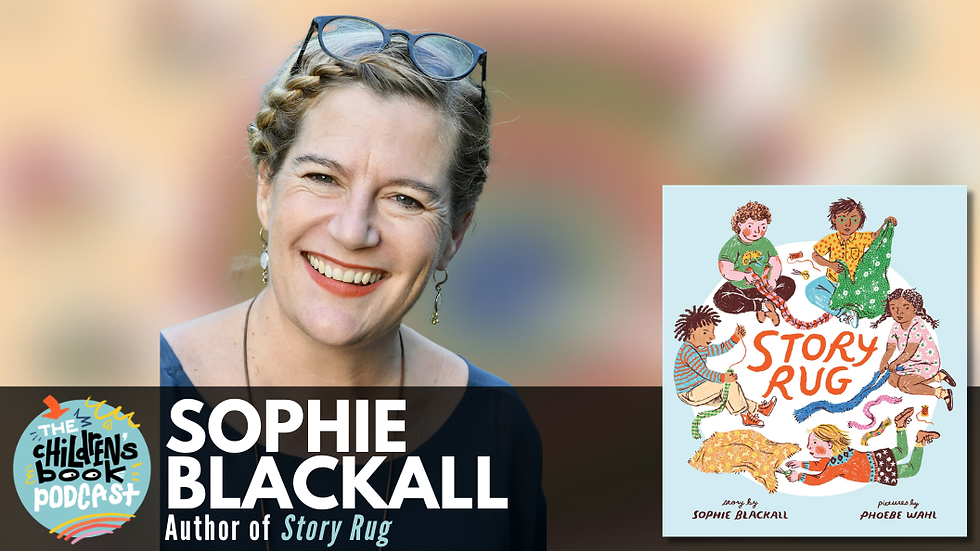
Sophie Blackall, author of Story Rug (Little, Brown Books for Young Readers), illustrated by Phoebe Wahl, joins Matthew to talk about being bound together in community through listening and making things with our hands.
Listen along:
About the book: Story Rug by Sophie Blackall; Illustrated by Phoebe Wahl. Published by Little, Brown Books for Young Readers.

From two-time Caldecott Medalist Sophie Blackall and beloved artist Phoebe Wahl comes a luminous book that braids together the joy of storytelling with the satisfaction of learning a new craft.
The children of Class 203 are learning to braid. They started with hair and shoelaces, and now the children have brought rags from home. Their braid gets longer and longer until one idea transforms it into an extraordinary surprise for their teacher.
Here is the story of a rag rug, woven through with the stories of the scraps used to create it and those told during its making. The result is a special handmade spot where the whole class can gather, ready for more stories.
This beguiling celebration of storytelling is woven through with an easy-to-learn and impressive craft project, including instructions, will have readers reaching for scraps to make their own rag rug.
More:
Visit Sophie Blackall online at www.sophieblackall.com
Learn more about Boyds Mills and their upcoming programs by visiting www.boydsmills.org.
Transcript:
NOTE: Transcript created by Descript. I've attempted to clean up any typos, grammatical errors, and formatting errors where possible.
Sophie: It was such a joy to make this book. Can I tell you why? Because, Matthew, I didn't do the illustrations for this book.
Matthew: That is the voice of Sophie Blackall, two-time Caldecott medal winner for Hello, Lighthouse, written and illustrated by Sophie, and Finding Winnie: The True Story of the World’s Most Famous Bear, written by Lindsay Mattick. Sophie’s latest book is called Story Rug (Little, Brown Books for Young Readers), and it is illustrated by Phoebe Wahl, marking the first time Sophie has written a book and not illustrated it. And my goodness Phoebe does a dazzling job!
Welcome back to the Children’s Book Podcast, where we celebrate the books and creators who help young readers feel seen, supported, and understood. This episode is brought to you in partnership with Boyds Mills, positively impacting kids by amplifying the voices of storytellers who inspire children to become their best selves.
I’m your host, Matthew Winner—teacher, librarian, writer, and a fan of kids.
It was wonderful to welcome Sophie to the show and we seemed to connect on just the perfect day. It was a meeting of the mutual admiration society where we dove deep into craft, process, and inspiration.
Here are a few of the things I learned in this conversation:
NUMBER ONE: Sophie loves to explore the stories braided into a community. Every space has such stories, but it often takes being invited or welcomed into such a space in order to earn the right to hear these stories.
NUMBER TWO: This book centers around a classroom obsessed with braiding. Those of you who also teach young children know exactly this kind of class, where there’s always a “something” that the whole class obsesses over and becomes part of the defining characteristics of the class that year.
And NUMBER THREE: Sophie describes herself as being “all curious tangents”. What a great place to find yourself as a storyteller!
So, a little about Story Rug (Little, Brown Books for Young Readers) from the publisher:
“From two-time Caldecott Medalist Sophie Blackall and beloved artist Phoebe Wahl comes a luminous book that braids together the joy of storytelling with the satisfaction of learning a new craft.
The children of Class 203 are learning to braid. They started with hair and shoelaces, and now the children have brought rags from home. Their braid gets longer and longer until one idea transforms it into an extraordinary surprise for their teacher.
Here is the story of a rag rug, woven through with the stories of the scraps used to create it and those told during its making. The result is a special handmade spot where the whole class can gather, ready for more stories.
This beguiling celebration of storytelling is woven through with an easy-to-learn and impressive craft project, including instructions, that will have readers reaching for scraps to make their own rag rug.”
Let’s embark on some curious tangents, shall we?
Please welcome Sophie Blackall to the podcast.
Sophie: Hi, I'm Sophie Blackall. I am an author and an illustrator of children's books about 60-something of them now, I think, which makes me very old and I also run a creative retreat for the children's book community in [00:01:00] Upstate New York, which is called Milkwood.
Matthew: Welcome back, Sophie. I'm so glad you're here.
Sophie: I'm happy to be here, Matthew Winner.
Matthew: I love that 60 books means not that you are old, but that you- ... have stories to tell. God bless you for telling those stories and for continuing to find ways to tell those stories. We're gonna talk about stories in a moment too that you've been working on and different ways you're working, but first may I please ask you what's giving you hope today?
Sophie: Ah, I love this question. So can I tell you a little story about today? This morning I got up and I walked around the park that is outside our building in Brooklyn, New York. It's called Sunset Park, and it's one of my favorite places in the world. It's been there for over 100 years. And this morning when I walked through the park, there were about 120 older Chinese folks sweeping the park, and they had long-handled [00:02:00] brooms, and they had made dustpans out of maybe like kitty litter boxes that had been cut on the diagonal and screwed onto poles, and they were sweeping the park.
And on the other side of the park, there was a man practicing his clarinet. There were siblings from my building walking to school, and they were brother and sister, and they were just cracking each other up. They were just laughing from one side across the diagonal to the other. There were dogs rolling around in the new spring grass.
The sun was just barely up, but it was golden. There was an older woman collecting dandelion leaves, like the freshest, best dandelion leaves she could find. And there was a teenage girl who stopped in her tracks and asked her what she was doing, and they had a whole conversation. And this was all on my loop around the park.
And as I left the park, there was one of the old men with his broom and his dustpan saw the school [00:03:00] bus with one of his eyes and the other eye saw a dad and his son running. And this man with his broom stopped the school bus because he just saw this whole thing happening. And the entire... I just... I came back to my apartment just like beaming from ear to ear 'cause it just felt like all of this was the best we can possibly be.
It was everybody was doing something that made them happy, that was useful, that was productive, that was engaging with the, this wonderful park that we get to share as a community. They were making it better, and they were seeing each other. They were seeing each other and making each other laugh or telling each other something they didn't know before or stopping a school bus so a kid could get to school on time.
It was the best. Made me so glad to live in Brooklyn. It made me feel very hopeful.
Matthew: That's beautiful. That's [00:04:00] so beautiful. I'm so glad that- that was your experience, that you got to be a part of just walking through as well, walking through the world and sharing that moment with all of them. And goodness, you make me think of my Grammy winner- Oh
God rest her soul because she used to make dandelion salad, and my dad would talk about that- Ah ... dandelion salad that he loved. Yeah. I, yeah.
Sophie: Oh, I love that. And the thing is the park is there all the time, and there are always people in the park, and maybe some days there are people h- just having a terrible day, and they've just, st- stepped in dog poo, and things are not going well.
And the clarinet player's music is just all blown all over the ... who knows? Everybody has different kinds of days. But it was a reminder to me that when you keep your eyes open and your ears open and look around you there's always funny, lovely, beautiful, interesting things to see.
Matthew: That's true. And to be a person, to be a child, to be an [00:05:00] adult, to be a person who is able to look or to remind yourself and ourselves to look, I think is good practice, too. Sofie, I feel that in the school library all the time, that if I just look, there are beautiful things happening almost endlessly. It's also a very- Yeah
stressful job, and- ... can be overwhelming. And maybe the answer is that we see what we're looking for So to be able- Yes ... to put on those glasses of hope and look for that is a choice that I'm glad you're reminding us we can choose. Hey you've got a number of books constantly coming out.
Next, I feel like if by the time we end this conversation, you'll be like, "No, I'm up to 65 now." But I really connected with this new book called Story Rug. Goodness. Oh. I thought it was beautiful. I thought it was, much like your Hope story just a glimpse, a looking in, and I love that. I love the [00:06:00] illustrations.
I would love for you, though, to share a brief book talk of Story Rug for those readers that haven't encountered it yet.
Sophie: Yes. They... I'm not sure when this podcast will air, but it is, at the time of us talking, Matthew, it is not yet out in the world. It will come out summer '26. It is called Story Rug, and it is the story of a second-grade class who is obsessed.
They are obsessed with braiding. When I was a kid, we had many obsessions- ... knitting and, oh, yo-yos and all different kinds of things, but this particular class is obsessed with braiding. And they are braiding everything they can possibly braid, but there's a kid called Noah who has a problem because Noah doesn't have anything to braid.
Noah has short hair. Noah has Velcro on his shoes and no laces. All of the ponies in the class are taken up with other kids, so no manes or tails to braid. Noah is in a pickle. But his teacher, Miss Morena, gives him a dust board rag, tears it into three [00:07:00] strips, and Noah is away. And then these three strips of fabric get joined onto other strips of fabric that come from all of the kids, first of all, from Noah's home, and then all of the kids join in on this craze.
And collectively, they make something for their classroom that is a combination of all of their home lives and the textiles and fabrics that have s- significant meaning to them in one way or another. And they're woven together. They're braided together to make something that is bigger than all of them combined.
And while they're doing this project, they're listening to stories, and I love the idea that when we're making something with our hands and listening to a story, that those two things become bound together. And so then the thing that they make at the end resonates with all of those stories, the stories that they've brought from home in the fabric that they've donated to the project and the stories that they've listened to and shared while they were making the [00:08:00] project.
It was such a joy to make this book. Can I tell you why?
Matthew: I feel like I know why.
Sophie: But I can't wait
Matthew: to hear you say it.
Sophie: Because, Matthew I didn't do the illustrations for this book. It was the very first time- Didn't you say it was a joy to not do- ... I wrote a story I can't believe you. Here's the...
maybe we can talk about this. Walk me through it. But,
Matthew: you wrote- Okay. You're right. We're, we are before the book publishes, so when I found the review spread on Edelweiss, on, on the tool we use, reviewers use to, to preview there was a... And I'm not used to seeing this because probably I'm a librarian, so I don't get this sent to me, but there was a letter to booksellers that you had written explaining why you didn't do the illustrations, and I l- I loved it.
Sophie, it was so beautiful. I don't- I'm not gonna ask you to read it, but I'd love for you to tell us why you are not the illustrator and the [00:09:00] wonderful way you came to realize you weren't supposed to be
Sophie: so I had been thinking about Story Rug for such a long time, like years and years.
And by the time I actually wrote the story, I could see the illustrations I would make in my head. I could see them so clearly, it was as though I had already made them. And suddenly I ... It wasn't the puzzle that I look for, when I'm making a book. I love for it to be a little bit shimmery in my peripheral vision, to not look at it too closely because then I, it'll disappear.
I love that experience where it starts to take shape. But this, for me, was clear as day. I knew exactly how I would illustrate it, and so it felt like I'd already done it. And so I wondered aloud to my editor, Susan Rich at Little Brown, who is a genius, what it would be like if someone else might illustrate it and how thrilling that would be.
And we immediately thought of Phoebe Wahl. We're both very big fans of Phoebe's work. Oh. I don't know Wahl. And what ... Oh, she's [00:10:00] just so wonderful. And I knew she would bring the things that she brings to every book that she does, which is her warmth and the life of her carefully observed, vivid detail, to all the characters that she puts into things and the environment.
You could stare at them for hours, and they just feel so true. Her drawings feel so true. And then as I started to see these drawings take shape, oh, what a gift. And then the funny thing is that I can no longer remember what mine looked like. They've gone. They've totally been superseded by Phoebe's drawings, which are the real and true drawings for this book-
Matthew: I love-
Sophie: just as it should be ...
Matthew: I love that, that you're at a point where it where Phoebe's art is true, is the truth of this book. And so your eyes now can only see what's true. It's- Yeah ... it's beautiful. It's just, it's incredible. It's, ... years and years ago, I spoke with- [00:11:00] Adam Rex, who wrote a book called School's First Day of School, and he might have been the first person- Yes
to ever tell me, 'cause that was illustrated by Christian Robinson. And, and- Yeah ... might have been the first person I had ever talked to up to that point, that said, Adam being a person who does write and illustrate, but he just said, "I wrote this book and it just felt like my style, it just didn't work on it."
And he just found the conundrum of I wrote this book, but I can't be the illustrator on it. It doesn't work. To hear you approach it in a similar but different way of it's not a puzzle for me. I like when it shimmers. It's not a puzzle, is-
Sophie: Yeah ...
Matthew: is, there's a m- magic to that, that I hope other writers listening and illustrators listening, storytellers listening will, will hear and go, "Oh, I can do that.
I don't have to do things all the way that I always do. I can pick up a different medium or I can try writing it in verse, or I could try something that just feels like this is not the way it's supposed to be." Oh, that's
Sophie: cool. [00:12:00] The other lovely part of it is the joy of collaboration. Oh, that's true.
Yeah. And, it's what this book is about, of course. But it's doing half of something and then allowing somebody else to do the other half, and that the two parts are greater the, than, that the whole is greater than the sum- Yeah ... of the two parts. And I feel like that when I get to illustrate somebody else's text, and and but for it to go the other way was utterly thrilling.
Matthew: Oh, it's so delightful that I don't know where you stop and she begins. Did you leave like illustration notes or something? When I write-
Sophie: Oh, heavens no.
Matthew: Oh, I love... I was gonna say, when I write, I try to be sparse, but I do sometimes include illustration notes. The way that Phoebe has interpreted the teacher in particular, I was like, "Oh, I love this teacher."
Yeah. "This teacher's great." Yeah. And-
Sophie: She's so great ...
Matthew: you, of course, have given names to characters to paint a beautiful, inclusive [00:13:00] room of children- But it also takes a teacher stepping into that room to make the space reflect everyone belonging in that room. And to- ... and to have Phoebe take up that charge and do that is, is beautiful.
Sophie: And I was talking to, it's a conversation that, that we're all having constantly at the moment in one form or another or another about AI and the impact of AI and and on children's books especially. And we don't need to talk about that too much at all 'cause it's the opposite of feeling hopeful about things.
It's the opposite of my walk in the park this morning. It's also the opposite of- However- ... writing children's books, if we can
Matthew: be clear.
Sophie: It is. I'll let you know where I
Matthew: stand on it.
Sophie: However, I posted some images from children's books I've seen lately, and I included one of Phoebe's in there of drawings that I think are the antithesis of AI because they show the [00:14:00] most perfectly wonderful glimpses of humanity.
And what makes Phoebe's drawings in this book so true, as I was saying before, are those glimpses. You feel like you know these characters, and the details that she puts in them of, a kid's tag sticking out of the back of their T-shirt or... You know- Yes ... it's those kinds of things where the crafts they've made out of toilet paper rolls and it's it, you recognize the truth in all of these pictures, and I love that so much.
And I think that's what we, that's what we've all gotta strive for going forward in the books that we make.
Matthew: To me, I would say it goes back to noticing. To really- ... notice. We- computers can't do that. The fact that you, Sophie, noticed that-- and you've been around small humans, so of course you've noticed.
But you've noticed that it's a thing for classes to become obsessed with a thing. I was a classroom teacher before being a librarian, and still, that was years ago, still I [00:15:00] think about in our fourth-grade classroom, those two years that I had and the year before when I was interning, I could tell you what those classes were into.
'Cause it was like we're this little community. This is what identifies us. And braiding was the thing. Or whatever it was- Yeah ... in our group was the thing. In our-- in one of my classes they loved making cards with movable pieces. Oh, great. I showed them some Robert Sabuda work afterward, and we were, like, learning how to make pop-up, simple pop-up pieces.
At the time, he had stuff on his website that you could print and cut and whatever. But it was because they, the class, showed me, "Oh, you like this. You like doing this? Let me feed- Yeah ... that- Yes ... and see what comes of it." And I have a smile folder. When we were in undergrad, I had a mentor that said, "Teachers or future teachers, you all need to keep a smile folder."
A smile folder is a folder that whenever you get a nice letter or a drawing from a kid or whatever- ... from the admin or whoever you receive it from, you put it in that [00:16:00] folder so that when the low days come, and they will come, you can go back to that smile folder and be reminded of the joy.
Sophie, I think I'm on smile folder number four or five. And I still have that art from that class, and I still think about it. There's a fishing birthday card that one of the kids made me that has that paper mechanic in it. And I think about it all the time. I love that. So good on you to-
Sophie: Oh
Matthew: recognize the trueness of a class having a thing.
Sophie: I have folders on my studio shelf, and one says boring things, and one says nice things. And the boring things are, receipts and tax returns and insurance documents. And then the nice things are mostly letters from kids.
Matthew: Yeah. Yeah, I believe that.
Okay, so we hopped around in our conversation which I adore. I love talking about- That's my
Sophie: favorite thing ...
Matthew: what you bring into this space and also what you observe. Classroom spaces are it does, not gonna surprise you for me to say as a teacher- ... that I just feel like they're one of the most holy [00:17:00] spaces we have on this planet.
It's so pure and so earnest. But I wanna ask you, being a learner, if every book you make teaches you something. I get from you that every story you bring forward you want to have that puzzle quality, that, that shimmeriness that you're trying to bring- ... into focus. On the other side of it, on the other side of having Phoebe done having done this artwork and having you see it and recognize the truth in it I can see what you might take from this process.
Do you find that with each work? Are you finding that each book is teaching you something? Or from the other end, that there's a quality that makes you say yes to illustrating this person's manuscript or something?
Sophie: Oh, definitely. But I think that's also just a way of going through the world and and curiosity, which I think is one of the greatest gifts- Yeah
we're given as human beings. And I'm always a little surprised when people don't exercise it 'cause we're all, we're [00:18:00] we all have it. I'm just thinking of ... Anyway, I'll, - All right ... I've gone off on a tangent already in my head. This is the problem, Matthew. I'm all curious- ... tangents.
All curious. I am, I'm writing a book for grownups right now, which is called The Sea, and this book is because I realized that everything I'm interested in sooner or later winds up at the sea or down at the sea. And it has been the most thrilling, giddy, intoxicating ride of I just can't stop. And I've handed in this manuscript, which is 60,000 words, and I'm feeling a little bereft because I, it's, I- I can't keep researching.
I can't keep writing. What am I gonna do? And of course, it's just I just move on to the next thing. But a kid was asking me recently if I'm still interested in lighthouses, and, 'cause I made a book about a lighthouse some years ago. And I said, "I am [00:19:00] still so interested in lighthouses," because some of my curiosities have become passions and then I, yeah.
The, I learn about them, I make a book about them because I'm interested in that thing, and then I don't stop being interested in that thing. But yes, every book is a puzzle. Every book is something to pursue to learn about something I didn't know before. This morning I was reading about knots, K-O, K-N-O-T-S, knots.
And then I got down this rabbit hole- That did you know there's a thing called an unknot?
Matthew: An unknot.
Sophie: And an un- an unknot is a circle. Can you believe it? I could not believe it. But now I believe it. This is just, this is thrilling. And the per- the people who are obsessed with knots, which I think I am rapidly going to become one of these people they talk about knottiness and [00:20:00] beknottedness, and the vocabulary in knot tying world is extraordinary.
And I'm deep in the, I'm deep in the knottiness of it all. So yes, every book. And I don't know if this is a book or not, 'cause half the time you'll go down a rabbit hole and it will just end up in other rabbit holes, and it takes a while before... I don't know if you feel like this, Matthew, as a writer.
Yeah. But that's the joy of it. And then- I was just gonna say that journey ... maybe you pop your head up somewhere where you didn't think you would land at all, but there you are.
Matthew: Isn't it beautiful that- You are not the same writer as you were yesterday, the day before, because you keep pursuing. Oh, I wouldn't have thought to approach a story or to approach a problem that a character is facing.
I love when a character presents me with a problem, and I'm like I don't know how you're gonna solve it. I guess I need to get to know you better so I can figure out how you're gonna solve that problem alongside you." But I love [00:21:00] that everything counts, everything matters. It's all learning. It's all contributing. It's no different... Again, I come from teaching, so it's no different than any side route we take to get to our destination enriches, helps us see something more clearly or appreciate it more, more fully. Also, I would love to say, because I ... Maybe because I w- I'm a f- former Cub Scout, Boy Scout.
I love the videos, and my grandfather used to be this way, of people that can flip the rope in the air and it becomes the knot or, or- Oh ... flip it around the pole and twist it. And knots are fascinating to me 'cause I know if I went slow, I could maybe understand how they work, but they just feel like magic to me.
Again, they're like the most logical magic. I can't even articulate- ... what is so fascinating about knots to me- Yeah ... other than it feels like they shouldn't work, or that one looks like it should hold tight, but when you pull it, it just comes loose. Or when you pull it this way, it becomes tighter. How? [00:22:00] How?
I don't understand. How?
Sophie: How?
Matthew: But yeah. Yeah.
Sophie: It's ... Yeah. It is fascinating. And they are also to use them as a metaphor for what we were just talking about they are ways of telling stories. And as a... And I'm sure you know about this but I was reading recently about navigation and early forms of celestial and maritime navigation.
So how people would the Polynesians would sail by the stars and the the waves. There would be pattern, wave patterns that they would lie down in their boats and feel the patterns, and they would be able to find themselves from one island to the next based on these various skills of navigation.
And these- Patterns of celestial and marine navigation are the same way that we still ta- tell stories. And they the navigational skills became stories so that people would tell them over and over again, and the two things [00:23:00] are deeply linked in our brains. So reading maps and navigating and finding our way from one place to a next is also how we remember history, how we plan for the future, and how we ground where we are in any given time, and it all relates to writing and storytelling.
Matthew: Oh, that's the best. That- ... that knowledge, you need to... You're in Brooklyn. You need to be on the next Moth Story Hour and share that. That's incredible. Sophie, I always value our time together, and I always watch it go way too fast. But I am privileged to be able to close my time bringing us back to children to ask you this.
I will see a library full of children tomorrow morning. Sophie, is there a message I can bring to them from you?
Sophie: Aw. Could you tell them, please, Matthew Winner, could you tell your kids that I am interested in them, that they are all interesting? And I'm not sure if I will get to meet them [00:24:00] specifically, but that doesn't mean that I'm not interested in them.
And I want them to know that they are the most interesting when they are themselves and when they find the things that make them feel most like themselves. And sometimes I think we try to be like somebody else. We try to fit what we do into some kind of pattern of what other people do, and it's good to remember that we're at our most interesting when we find the thing that makes us feel most like ourselves.
So please tell them that I'm interested in them, and that I think about them all when I'm making my books, and I hope I do get to meet them someday. But I hope they tell their own stories as well, 'cause I bet they'll be interesting.
Matthew: Thank you to Sophie Blackall for joining me on the Children’s Book Podcast.
You can pick up your own copy of Story Rug (Little, Brown Books for Young Readers) wherever books are found. Consider supporting independent bookstores by shopping through Bookshop.org.
Our podcast logo was created by Duke Stebbins (https://stebs.design/).
Our music is by Podington Bear.
Podcast hosting by Libsyn.
You can support the show and buy me a coffee at matthewcwinner.com or by clicking the link in the show notes.
And on that note…
Be well. And read on.