Constantly Surprising with Matthew Swanson and Robbi Behr

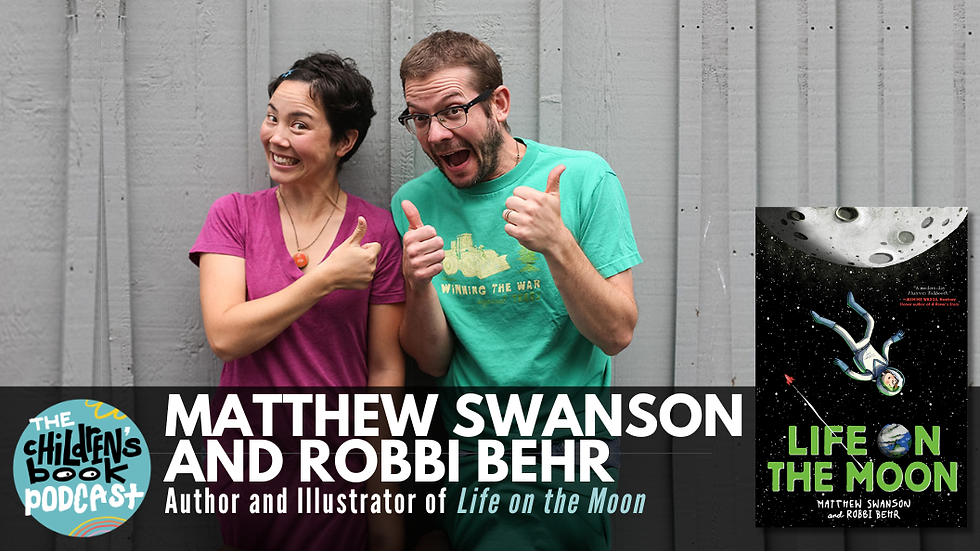
Matthew Swanson and Robbi Behr, author and illustrator of Life on the Moon (Knopf Books for Young Readers), join Matthew to talk about things so awful they can only be encountered through humor.
Listen along:
About the book: Life on the Moon by Matthew Swanson and Robbi Behr. Published by Knopf Books for Young Readers.
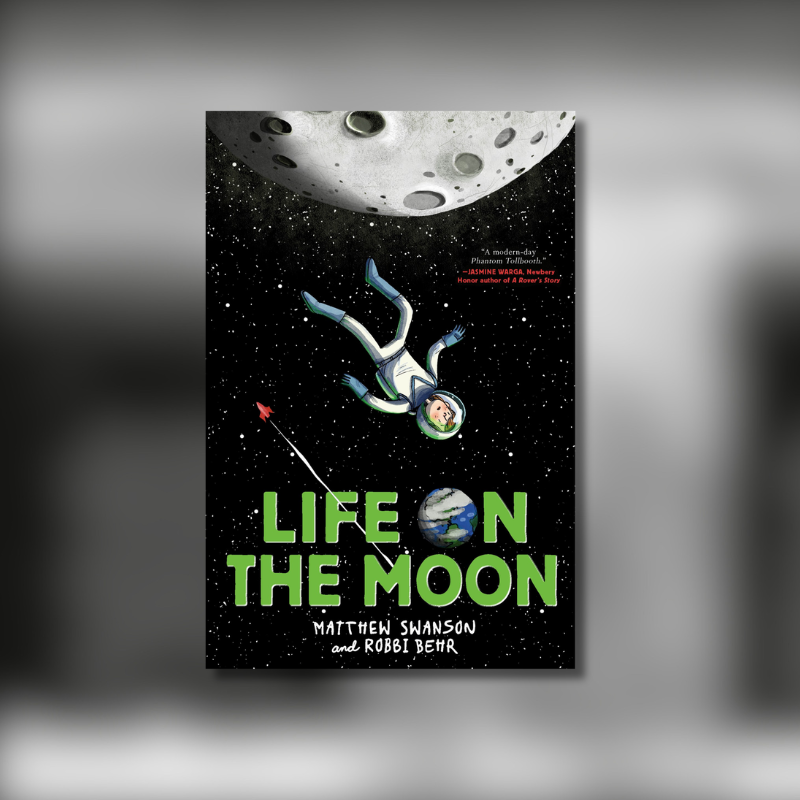
The extraordinary tale of a curious boy sent to live on the moon, the wondrous discoveries he makes, and the courage it takes to speak a truth no one wants to believe.
The first rule of life on the moon is: There is no life on the moon.
The second rule is: Don't ask questions.
12-year-old Leo gets a once-in-a-lifetime opportunity to join the very first Moon colony. He’s excited to be part of the top-secret mission, but things quickly go off the rails. Right after his family lands on the Moon, Leo’s dad is called off on an urgent mission from which he never returns. The authorities claim the mission never existed, and Leo’s dad is accused of desertion.
Leo goes looking for his dad and discovers far more than he bargained for. Everyone in the colony insists there’s NO life on the Moon. But Leo’s explorations reveal a landscape brimming with extraordinary creatures—with baffling behaviors and beliefs.
Leo’s big question is: why keep Moon life a secret? Who stands to gain? And how can he find a way to save his new Moon friends before the lie becomes a reality?
More:
Visit Matthew Swanson and Robbi Behr online at robbiandmatthew.com
Learn more about Boyds Mills and their upcoming programs by visiting www.boydsmills.org.
Transcript:
NOTE: Transcript created by Descript. I've attempted to clean up any typos, grammatical errors, and formatting errors where possible.
Robbi: (4:51) Yeah. Yeah. It's really fun and honestly, we have the best job every we always say we walk into a school, everybody loves us. They, oh, yeah, they come to us and hug us, and then we leave at the end of the day,
Matthew S: As opposed to you, sir, who goes every single day and serves your community every single day.
Robbi: Incredible.
Matthew S: All respect to you and what you do.
Matthew: That is the voice of Robbi Behr and Matthew Swanson, the illustrator and author of The Cookie Chronicles series as well as the incredible humans behind the Busload of Books tour. Matthew and Robbi’s newest novel is a stand-alone title called Life on the Moon (Knopf Books for Young Readers).
Welcome back to the Children’s Book Podcast, where we celebrate the books and creators who help young readers feel seen, supported, and understood. This episode is brought to you in partnership with Boyds Mills, positively impacting kids by amplifying the voices of storytellers who inspire children to become their best selves.
I’m your host, Matthew Winner—teacher, librarian, writer, and a fan of kids.
Matthew and Robbi have been friends of the show for over a decade, but also they’ve been terrific pals and terrific supporters of me as a human being. And also of my kids as fellow human beings. It’s actually one of the undeniable qualities of Robbi and of Matthew: Their support and love and respect of other humans, especially the school-age kind, is… well… undeniable.
Here are a few of the things I learned in this conversation:
NUMBER ONE: They use books to connect with other people. This might be something you’ve thought of yourself as an author or illustrator or teacher or librarian or parent. But to hear it communicated this way, as something of a charge, a mission, is awesome.
NUMBER TWO: This is a story about the dangers of making assumptions. If that’s not universal, I’m not sure what is. But Matthew does a really cool thing in this story that employs hive mind thinking in three different ways or perspectives. One is through the colonists of the moon and how the human experience is communicated through Leo, the story’s protagonist. The second is through the literal shared mind of the Valrootens. And the third is communicated through the absurd, yet connected mindset of the artificial intelligence controlling the rovers and other machinery. So many assumptions. It’s what drives the engaging dynamic of this story.
And NUMBER THREE: Sometimes things in our world are so awful, they can only be encountered through humor.
So, a little about Life on the Moon (Knopf Books for Young Readers) from the publisher:
“The extraordinary tale of a curious boy sent to live on the moon, the wondrous discoveries he makes, and the courage it takes to speak a truth no one wants to believe.
The first rule of life on the moon is: There is no life on the moon.
The second rule is: Don't ask questions.
12-year-old Leo gets a once-in-a-lifetime opportunity to join the very first Moon colony. He’s excited to be part of the top-secret mission, but things quickly go off the rails. Right after his family lands on the Moon, Leo’s dad is called off on an urgent mission from which he never returns. The authorities claim the mission never existed, and Leo’s dad is accused of desertion.
Leo goes looking for his dad and discovers far more than he bargained for. Everyone in the colony insists there’s NO life on the Moon. But Leo’s explorations reveal a landscape brimming with extraordinary creatures—with baffling behaviors and beliefs.
Leo’s big question is: why keep Moon life a secret? Who stands to gain? And how can he find a way to save his new Moon friends before the lie becomes a reality?”
AND there’s an audiobook adaptation! Here’s a preview from the publisher!
[AUDIO CLIP PROVIDED BY PUBLISHER]
Time for some reckless joy through a new perspective!
Please welcome Matthew Swanson and Robbi Behr to the podcast.
Matthew S: Alright Matthew. My name is Matthew Swanson. I am, I suppose foremost a children's author, but I'm also a commercial salmon fisherman and a literacy advocate and a father of four and a collaborator with the robler over here.
Matthew: Oh, I like that name.
The Robler.
Robbi: The robler.
Matthew S: Why was there that uncomfortable Pause. Now
Robbi: that's someone that's going viral. I'm like, hold on.
Matthew S: Do you want me to redo that with the esteemed and elevated Rob K Bear? Yes. Okay.
Robbi: Wait, was that all you were supposed to say?
Matthew S: I don't know. I didn't want to overdo it. I could keep going and
Robbi: going.
Same name, I guess that's. My name is Robbie Bear and I am an illustrator, and I do all those things that Matthew does as well, except for collaborate with this mysterious robler, whoever that may be.
Matthew S: Who do you [00:01:00]
Robbi: collaborate with? I collaborate with Matthew. Ah.
Matthew S: See, that was your chance to
Robbi: not, oh, I should have said
Matthew S: this.
Yeah, you had a chance.
Robbi: Matthew wants to be called. Maddie ACEs and I refuse.
Matthew S: That's what people on the street call
Robbi: me. No,
Matthew S: it's people in dark corners. I'm,
I've never met this. Do they snap people?
Matthew: Do they snap as they approach you?
Matthew S: Heck
Robbi: yeah. Yes. That's the kind of, that's the kind of gangs we're dealing with.
Matthew S: And then there would be a rumble except they see me and turn the other way. Ooh.
Matthew: Oh, I like this. I like the story very much. All right welcome. Glad you're both here. Thank you. We're both in sunny Maryland. It's like a beautiful spring day outside, and you were just out, maybe you were indoors for, were you indoors for soccer?
We were indoors
Robbi: for soccer,
Matthew: but we
were
Robbi: outdoors before and after soccer.
Matthew S: It's perfect,
Matthew: and it's lovely day. That's lovely. The sun is putting me in a wonderful mood. So as I ask this I'm thinking about just, the headspace that good weather puts me in. So tell me, Robbie, tell me what's giving you hope today, now that I'm meeting you on this particular day.
Robbi: Let me tell you, we just came back from a week of school visits in Alabama. And the thing that gives me hope is meeting kids [00:02:00] who are so thoroughly themselves. They just say, they'll say whatever comes their head. They don't feel they don't feel embarrassed. They don't, they're just living their best life.
And that gives me hope. 'cause that is the generation that's coming up. And hopefully they will maintain that sense of self in order to, fix a lot of things that we've broken.
Matthew: Ah, Matthew, what's giving you hope today?
Matthew S: I will piggyback onto the recent trip 'cause it's fresh in our memory and we love, making books is really fun, but what we love is being able to use those books to connect with other people.
And of course the bridge often between our books and the kids is the teachers and librarians. So spending the week with these people who have made it their life's work. To create that space where kids can connect with books, connect with authors, find out who they are by accessing content that helps them feel seen or understood.
Our our our host at our school on Friday, which was a busload of [00:03:00] Books visit. This is the nonprofit we run that brings Preau visits and free books to kids in Title One communities. Our host there. Obviously someone who, whose day job is enough. It is exhausting, but she relentlessly applies for grants to create additional opportunities.
Robbi: Kathy Al, she's amazing. She yeah, she applies for grants. She got the busload of books visit, but she also has gotten a grant where she has an afterschool program from three to six every day. And she does that's outside of her, regular job description. She's doing that every day for kids, and this is the end of grant season.
So she was feeling very relieved that it was over, but that's a time where she spends. All of her extra time writing grants and hoping that she can get more opportunities for her students
Matthew S: because these kids need more.
Robbi: Yeah.
Matthew S: You deserve more. And she knows no one is gonna do it if she doesn't.
Yeah. So she shows up for them. 'cause somebody needs to,
Robbi: yeah. It's really inspiring.
Matthew: And she's got the skill of grant writing, which is something that you need to work on to to get. I hope she has some support that [00:04:00] it's not just her, but maybe her PTA or something like that is also working with her, but clearly she has a school of support in order to help make that pathway available for the students.
That's a great thing. I'm glad you were able to go visit with her and all of the school.
Robbi: Yeah. It's always, it's very gratifying.
Matthew S: We're, yeah, we're and inspiring. And now it's time to take all that good energy and come back to the studio and make more books for those kids.
Matthew: It's a good rhythm, isn't it?
Yeah, I imagine. Make a book. It's not unlike musicians making an album and going out and touring the album and seeing how, depending on when you catch readers in that tour, some of the books have already reached some of those kids, so they're already resonating with it. And in some cases, when you were visiting other schools, I assume these schools on this past visit, this new book isn't out yet, so you're having a chance to preview and to build that excitement.
That's cool.
Robbi: Yeah. Yeah. It's really fun and honestly, we have the best job every we always say we walk into a school, everybody loves us. They, oh, yeah, they come to us [00:05:00] and hug us, and then we leave at the end of the day,
Matthew S: as opposed to you, sir, who goes every single day and serves your community every single day.
Incredible. All respect to you and what you do. Yes.
Matthew: I get drawings all the time. That makes it, you saw? 'cause I put 'em on my windows. It makes the everything, makes everything, makes the job the best. But I like, I always like the drawings. Hey, talk to me about this brand new book, Matthew. You've got a in the last Cookie Chronicles there was a preview, there was a preview chapter, maybe
Matthew S: indeed.
Matthew: Of life on the moon. When this comes out the, when this episode comes out, the book will be out as well. Can you talk to me a little book, talk about this life on the moon?
Matthew S: Sure. Start. For people familiar with our previous work, this is our first standalone novel. So this is the story of Leo Brightstar 12-year-old boy who goes to the moon to start a new colony with his family.
He's looking for a fresh start. His parents just got divorced. His best friend just dumped him. He's really sad. He's looking to start over, and immediately upon arriving on the moon, his dad goes missing and Leo has to go find him. [00:06:00] And he goes off on this adventure equipped with the knowledge that there is no life on the moon.
Because that's what the powers that be on the moon have insisted upon. But
Robbi: this is not true. This is not true. He discovers it's not true.
Matthew S: Almost instantly, he meets the Val Rutins, which is almost instantly this group of 354 interconnected, cute little tentacle creatures who
Robbi: interconnected mentally, not physically.
Matthew S: That's true. Although often they are touching each other 'cause they're friends. But Leo decides, oh my gosh this creatures are the best possible friends. They're kind, they are never jealous. They're never afraid because they. No,
Robbi: they're never embarrassed.
Matthew S: They're never embarrassed. And Leo said, this is how I want to feel.
So he says, I will do anything to protect you. And of course there is a moon monster rampaging around eating his friends. And so Leo decides he's going to protect them, but because he doesn't really understand how the moon works,
Robbi: monster really, to be fair to the moon, monster only eats one friend a day.
Matthew S: True. But Leo wants to put a stop to this. But because he doesn't really understand how the moon works, while he's trying to protect his friends, he puts them in utter peril. So it's really a book about [00:07:00] keeping an open mind and the dangers of making assumptions and the importance of putting things back together again.
Once you have discovered that what you thought was true is not, is that fair enough, Robbie? That's
Robbi: totally fair enough. However, you make this sound like a very. Serious book.
Matthew S: Well, Robbie, it deals with serious themes, but in it,
Robbi: but in
Matthew S: funny ways no. We we, I think it's a very funny book.
Robbi: It is funny,
Matthew S: and I think it is a Gorgeously Illustrated book, which you can't see on this podcast.
Yes. Is that every book Robbie and I make,
Matthew: You can, we can share video. We've got stuff that, that we'll be
able
Robbi: to look at. I do wanna point out from. The advanced readers.
Matthew: Oh yeah, these are unfinished drawings. Those
Robbi: are unfinished, and they look so much better than Look one.
Matthew: Look how unfinished.
Robbi: I know. Boom.
Matthew: That's
Matthew S: shocking and embarrassing
Matthew: probably on every single occurrence of art. I don't know that I've noticed in an unfinished in an arc like this, but every single occurrence of art that says art, not final art. Robbie wrote that in over and over, over stamp, over and over. Tell them
Matthew S: that this one is [00:08:00] also bad.
Matthew: Oh, really? It's not done.
Robbi: I didn't make them do that. No. But they must have sensed that I was not happy about how it was looking. Yeah. It looks much better in the final, in the finished version that everyone else will get. Good news.
Matthew S: We have been making books together for a really long time and we both agree that this is our best work.
Yeah. Or at least as far as we're concerned, we love this story and we are really excited to share it with people and it feels like something new. So if you think, our work check it out. 'cause it's a, for us, it's a different direction and we're really excited about it.
Matthew: Interesting too to approach a novel, novel having come off of a series.
For you to approach it and want to just make something standalone, self-contained. Maybe we could also say. That's great. Robbie, you starting something new? You had been doing Cookie Chronicles for a number of years. Yes. Was coming at a new project different, are you applying the same sort of I don't know.
You're applying the same skills as you do, as you are the same artist that continues to grow. But did it take. A process of [00:09:00] getting feedback from an art director. I hear that you are saying that you are you had thoughts about making sure we knew the art wasn't final yet but how was that, approach to creating a whole new cast of characters?
A whole new scene?
Robbi: Yeah. Absolutely. It's a different, you set up one world for one book series. Yeah. And there's, these couldn't be more different. The Cookie Chronicle series takes place in classrooms and in very much like earth spaces. Yeah. So there was a lot of drawing of desks.
There was a lot of drawing of houses. And so this one was exciting to try out because luckily Matthew's approach to Moon. As an entity is not a scientific approach.
Matthew S: Heck
Robbi: no, there's no science in this. There's very little science in this science fiction. And so I got to also be able to imagine a little bit more of a sort of.
Abstract, spectacular mu moonscape. The other thing was this, [00:10:00] I feel like this was more words, right?
Matthew S: This is the longest book we've
Robbi: published. This is the longest book we published. Okay. And so we knew from the start it's also a little bit more
Matthew S: older protagonist.
Robbi: Yeah. And so we knew from the start that we didn't want the.
Illustrations to be quite as dominating as they are in other books. In part I wanted them to evoke mood a lot more. Yeah. Rather than just following the action like continuously and having you be, having the action be shown. And so yes, it was a different approach.
We first thought that it was going to be in color.
When we first pitched it. I wanted it to be in color, and so the. First version also of the manuscript was a little bit wackier. It was a little, it was a lot looser and it was a lot less serious, thematically serious, even though the still funny things happen. And so the color version of this was a little bit more cartoony, a little bit more graphic, [00:11:00] and we pitched it and the editor, our editor, came back and was like, it's probably not gonna be in color.
And so I was like, ah. And then Matthew changed the writing. The writing changed enough that it became a little bit of a, more of a mood piece. And I wanted the illustrations to feel less like in your face and more like evoking an environment and kind of like giving a feeling rather than showing stuff.
And because I knew it was gonna be in black and white I toned it down and it has a much more, I would say an art, more artistic feel than the other books.
Matthew S: Yeah.
Robbi: So yeah. And then there, the character's character building was a little bit difficult. Matthew describes them somewhat vaguely.
I think the big piece that I had trouble with was this Moon monster. Who has hilarious nicknames? What is he called? Sometimes the robots or the rovers. Call him of
Matthew S: You. Put me on the spot here. Do you think I've read this book, Robbie? He wrote this book quite a long time ago.
They talk about his
Robbi: person like you. You
Matthew S: Yes.
Robbi: Stack of,
Matthew S: he's basically a big mouth with no eyes or no. [00:12:00] So this is like a big meatball with teeth.
Robbi: Yeah. Yes. And so in my brain, and the first version of this character that I did that lasted almost until finals was. Just these giant lips and teeth. It looked like.
It just looked like a pair of dentures running around, which to me. Is terrifying. I thought that was terrifying. Just s slobber like running out of his mouth and these big lips and these big teeth.
Matthew S: Our editor, I think correctly thought it might be better for storytelling if he was a little scarier since he is meant to be a manna.
Robbi: Silly. Yeah.
Matthew S: And
Robbi: I was like, no, that's terrifying to see, just like if you were on the moon and you saw just the pair of teeth running around with these,
Matthew S: you don't wanna lip hobby when she's been told to draw something differently. So there was a little bit of a patch there where I had to do a little talking to my friend here but we're really happy with how it turned out.
I think it's your, like you say, art, the most elegant, sophisticated, lovely art yet.
Matthew: Yeah, I agree.
Matthew S: Sorry.
Matthew: Sorry,
Matthew S: Matt. Matt.
Matthew: No, I was gonna say I agree. I was gonna say, Robbie, I feel like the art. [00:13:00] Is more cinematic. The best way I can describe it when I look at art is I always think about like camera positioning, if that makes sense.
Uhhuh, Uhhuh and on, on all so many of these threads you pull the camera way back,
Robbi: Uhhuh.
Matthew: And that both contributes to feeling alone on the moon, feeling alone in this space. And also it evokes more of the feeling of we don't know what's there. And that I think contributes to mood.
Really well. It's also great to have absurd things going on. We love that. Yes. But to pair it with you think you know the moon. 'cause the view you have always looks the same, but actually it looks perhaps even more desolate than you think. I thought it was a great
Robbi: approach. Love you. You are, Robbie is touched about to cry.
You're understanding me so well. In one of the reviews, they described it as Robbie's
Matthew S: cartoons,
Robbi: neat cartoons. And I was I hope that they come across as more than cartoons. Cinematic is a great adjective to describe. I
Matthew: have,
Robbi: thank you.
Matthew: There were so many spreads. I can't find it now 'cause I'm leafing through my copy.
But there [00:14:00] were so many spreads where you've got, for example, this is not gonna do it, but for example, you have a huge portion of the page is space. There's one where the, where two characters are just like spots of stars behind them and it's just, it's so evocative to, to feel like that's very not earth.
Matthew S: Yeah.
Matthew: And maybe that's one of the things that I'm drawn to about sci-fi is how very much, regardless of how much or how little science is in it, it's not here.
Robbi: Yes,
Matthew: there's always a quality to it that is earth-like as it might feel, whatever thing we're talking about that it's not. And so that to me as a reader, I think the reason why I'm drawn to that genre is because it, it challenges your assumptions.
You can't assume you know how anything works there because it's not where you are.
Robbi: Yeah.
Matthew: And so I think for you to approach it that way and have maybe fewer camera shots [00:15:00] that are tight on the characters or on the objects they're talking about, I'd much rather keep reminding us of everywhere you look it's space.
Robbi: Yeah. Ah, thank you. Good. Thank you, Matt. Yes. You understand me?
Matthew S: Thank you.
Matthew: That was good. I like your art. It's nice. Thank
Robbi: you. Wait
Matthew S: till you see
Robbi: the one that
Matthew S: is final.
Matthew: Wait till you see the final one. Yeah. Get me on that list. Matthew, I wanna talk to you about, you had mentioned this was the longest thing
Matthew S: Yeah.
Matthew: Published that you've done. I know you from so many years and from reading so much of your work, and you Robbie as well, to be funny. I like that, that you can't not write funny. That's I think personally, and I've maybe said it to you already on other recordings, but it feels like such a great way to connect with children is to, to not only not take things seriously, but in some cases, very much I don't know, you're somebody who blurbed the book.
Ja, it was Jasmine Warga. Oh, wow. Jasmine Warga, who blurbed your book, [00:16:00] compares it to the Phantom toll booth and the logic in the Phantom toll booth is almost accosting the main character, almost saying like, how dare you not agree with the logic of this environment? And I like that you have.
Adults in this story communicating to children in exactly that way. How dare you not know these rules? You know that you're not allowed to ask questions, you will stop asking questions right now. It's absurd and wonderful, and weirdly to this reader feels safe for you to be so unbelievably absurd with them.
I like that, but I don't think I've ever had a chance to ask you. With text bordering so much on that line of absurdist and ridiculous, where does that come from for you? Did you find as a child comfort in that humor or in relating to the world that way?
Matthew S: It's funny [00:17:00] until I started thinking about this particular question.
I hadn't asked it of myself. And I think that it was my friends. I am drawn to people who use humor as a way to express affection, emotion for whom the language is its own pastime. My friends and I would just sit around and talk to each other. And say nothing much of substance, but use a language as this bridge to build something between us.
That is what language is. You said, kids it's a way to connect with kids. Yes. Reading should be fun and there's lots of different ways for reading to be fun, but for me, if I'm gonna tell a story, I want it to be constantly surprising. So there's lots of different kinds of humor. I am famously not a puns guy.
I am someone who likes to surprise with voice, and I think some of my favorite things about life on the Moon are the voice of the sort of AI rovers, how they speak and relate to Leo, and [00:18:00] also the surprising voice of a character without spoiler alerts, who we think is one kind of character who, when he finally gets the chance to open his mouth and speak, is in fact quite genteel and thoughtful, and the surprise of that inversion.
Is part of what makes it funny, I think. So humor to me is a way to access topics that are uncomfortable or hard to understand in a way that is both fun and keeps you in that space long enough to work through what is tricky about what's happening. So all of that sounds strategic and not, for me it's just, I like to write funny stuff so that it's very intuitive and it's what I do.
But when I try to unpack why and what's happening. It's because it's how I like to communicate. It's how I
Matthew: understand. Yeah. I like that you're saying it feels intuitive because it feels like that, that adage that we have of writing what you know. Yeah. It feels like you are writing the language that you've absorbed and that has felt.
Maybe we would say it's felt secure growing up.
Matthew S: Absolutely. [00:19:00]
Robbi: I would also say that absurdist strain,
Comes, I think comes from when you step back from almost anything that we just take for granted as adults. If, when I step back and I think of myself as a kid, when people would tell you things like recently somebody, one of our kids said, yeah.
As a joke, somebody told, it was like an April Fools thing as a joke. Somebody said that there were these birds and we went out and we. Had to like, make a funny sound to bring the birds in and we get, we made the, this food to put out for the birds and the whole thing was like this elaborate April fools joke to be like, Hey, that, I don't know, not that the birds don't exist, but like, why would a kid not believe, why would a kid not just take that at face value?
We, we tell them all the time, completely absurd things about the world that we live in, and they just have to be like, okay, I'll believe you that the sun's gonna come up tomorrow. Oh, that. Okay. I'll believe you that I get on this bus and you'll, and it'll bring me back [00:20:00] at some point. Yeah.
At the end of the day. They just have to believe the stuff we tell them. And if I were now a child in that world, I would question everything and I would find it all outrageous that we do these things. So I also think that your absurdist strain is sometimes stepping into the space of not knowing and.
That space of surprise where the next thing that somebody says isn't what you were expecting. Like most of the things that we say are completely absurd. I think.
Matthew: I think you're calling it out. I think we, yes. We take the absurdist and just make it the norm.
Robbi: Yeah. There's so many things that are norms that are completely absurd.
Matthew: Yeah. I wonder if that's not to get too heavy with us, but I wonder if that is our adult nature of squashing out wonder of yeah, there's like a way to explain all of that. So
Robbi: yeah,
Matthew: it's just what it is. Or why would you possibly think things could be as [00:21:00] wondrous as they are?
I don't
Robbi: know. I think it also helps us make sense of things like. I get that we have to categorize and define everything
Matthew: keeps
us
Matthew: safe as a species.
Robbi: Yes. Alright. But there's some
Matthew S: things that are so awful that they can only be truly encountered through humor because we need some sort of shield to hold two things in our head at once.
So I, I think humor's incredibly complex
And powerful. I will not give myself any sort of credit for using it in a thoughtful way. It's just what happens when I write. I was briefly a very terrible poet, Matthew, and I wrote very serious poems, and when I started writing songs with my guitar, I started writing funny songs and I thought that was the twist that unlocked the freedom to be humorous in communicating creatively.
So I'm really glad that I moved from my very serious bad poet phase and, discovered that humor's a powerful tool, and that it's not just for telling silly stories, but it's for telling stories with heart and purpose and [00:22:00] ideas, and that's a vehicle that can be a gift to someone. To let them stay with the story long enough to open it up and see what's inside
Matthew: is a skill that you just build and then maintain.
You've been writing this way for so many books that you're able to tap. Does it get difficult to find voice for a story?
Matthew S: No. And I'm sorry if that sounds obnoxious, but
Matthew: It's just No, to me, it sounds like your stories come out to me. They read as if you're just telling me, but I also know your voice really well.
But
Robbi: I would say Matthew's story, start with voice. He ha he usually figured out.
Matthew: Yeah.
Robbi: What it's, what the, how the characters are before he figures out why or what they are.
Matthew: Cool. So
Robbi: yeah.
Matthew S: And then I have to retrofit like a story out of it. Oh, it's so annoying. I've got all these wonderful voice studies and then someone needs it to have a beginning and middle and an end.
So that's the part that work for me. But the humor is the lightness and it's what keeps me. It's fun. And it's fun. Yeah. Yeah. For giving me a chance to think about [00:23:00] that.
Matthew: Yeah, no, it's, I think it's great and I don't ever want to take away the wonder from it. I wanna, I want things to stay as loose and pure as they can be.
But it just is, it's a neat quality. The voice that you have in your writing is something, that I'm drawn to, and I know that many readers, especially in my school, are drawn to.
And so it's neat to be able to ask you about it because it's. Not a voice that all writers have, nor should they, but it's, it's a voice that readers are drawn to and that's, thank you, a great quality.
Robbie,
Robbi: I have to cough. Excuse me.
Matthew S: Can this be the clip?
Robbi: It'll be the clip of me.
Matthew S: Bear coughs. We could analyze it. We can see what she's trying to say. All
Matthew: that's
Robbi: fantastic.
Matthew S: Are you quite done?
Robbi: I hope so.
Matthew S: Matthew and I are trying to have a serious conversation.
Robbi: You know what, A week of talking at school visits has like.
Matthew: No, I'm gonna leave it in. We've given it too much context now. I can't edit it out. I've given it too much context.
Robbi: No, I wasn't even a good copy,
Matthew: Robbie. Let me,
Robbi: [00:24:00] okay. Alright.
Matthew: Let thanks for making it a good cough. All
Matthew S: right.
Matthew: All right. Robbie, I wanna ask you, you've made these illustrated novels where you're creating hundreds of drawings for them and that's great and I appreciate your ability to.
I know it's like the skill of an illustrator, but I appreciate your ability to not give us the same view over and over. But I also know that deadlines can challenge creativity is the way I'm gonna put that as kindly as I can. That's
Robbi: a very good way to put it.
Matthew: So can you give me a glimpse into your workflow, your productivity that.
That sort of helps keep things playful in your art. You had all different art in life on the moon, and I've talked about how it really did look like the camera was placed in a very different way for this story, and I appreciated it and it fit the novel really well. But I know it's a tremendous amount of work for you to illustrate.
So maybe [00:25:00] just for this novel how was workflow and productivity managed?
Robbi: I love that this is what you're thinking about. I appreciate that because it is the thing that I find most difficult to manage. Is it okay? Yeah. I am somebody unfortunately who is quite motivated by deadlines. I guess fortunately it'd be worse to not be motivated by deadlines, but it's hard for me when a deadline is distant to understand that I can only do so much in a day.
And so while it's distant, I do a lot of frittering. And I think I am thinking I think my brain is working on this stuff, but it looks like I'm sitting at my desk doing nothing. Which Matthew finds somewhat excruciating. Matthew is someone who likes to get the project done as soon as possible and have months to think about it.
Matthew S: We could not work on things more differently, and although it is often vexing. I think it is also the secret sauce to how we've been able to keep working together for so long. So that's a nice [00:26:00] compliment. I'll be quiet. This is your turn, but I just wanna say, I wanna say that what you're saying is true.
Robbi: Yes. I'm not making up
Matthew S: No.
Robbi: So I'm
Matthew: bothered by it.
Thanks. Thanks for your contribution, Matthew. Robbie, please continue.
Robbi: Yes. So as the deadline approaches I do have it all. I do have it all mapped out. I do know how many. Drawings. I do need to get done in a day if I'm going to do it at a reasonable pace. And inevitably, I, I say seven pages a day, that's perfectly reasonable.
But then something happens and, the kids come in or, but this happens, or whatever happens, and I only get two pages done that day. And then the next day I have nine page or however, whatever the math works out to be. Yeah. And it snowballs as I get closer to the deadline and then probably two weeks out I start to panic and that is what puts me into high gear.
And then I can literally sometimes do 20 pages, 30 pages a day. If I'm on, like I get in a zone. Matthew has to like. [00:27:00] Throw food at me through the door. And otherwise not bother me. The kids have to, sometimes he has to take them out of the building and out of the state has to, he has to go on vacation while I get my deadline done.
So it is a little bit chaotic. And I do think that if I had, if I did it sooner and I had more time to reflect on it, I would go back and change things. It's always the final version of the book. I'm like, oh, why did I do it that way?
But the way that the schedules are set up, you have I have a certain amount of time to do sketches and the sketches.
I, I usually end up making more finished probably than they need to be. So that's good because then in the next round when I look at them, I can say, I don't really know why I did it that way and redo it. And I get feedback, you get feedback from the art director and I think because they're.
Are so many illustrations in these longer books that we do. I don't get as much feedback from the art directors because. I think 'cause there's just so much.
Matthew S: Yeah.
Robbi: I think for our picture books, we get lots more specific, like very [00:28:00] specific feedback. The feedback on these books is rather general
Matthew S: or maybe you were just spectacular on the first drive.
No, I think you're forgetting. They give us a lot of feedback. I really feel like,
Robbi: but it's not it feels more generalized and less specific. So that I don't feel like they're fine tuning anything. I feel like they're just saying I don't think you I don't understand what this is, what's happening here.
And then the next round is finalizing everything and it'll be I'll be curious to hear from you, Matthew, when you see the difference between what's in that book right now that you have the arc and the finished versions. I do feel that it jumps quite a bit in that final, version of drawing where I really polish things a lot, that it just takes it to a different level.
So my deadlines are broken out so that I do sketches first and then I have a time of feedback and a second round of sketches, and then I go into finals, and then I have feedback on the finals. But by the time I've gotten to finals, i'm not getting a lot of feedback for the last round.
Matthew: Okay.
Yeah, they're [00:29:00] pretty close then.
Robbi: Yeah. But I always, so far, knock on wood, I have always made my deadlines, but it has made Matthew's life very miserable.
Matthew S: Matthew loves every minute of it. Being your collaborator is my life's greatest pleasure.
Matthew: True. That's true.
Matthew S: That's true.
Matthew: Cool. Cool to learn though, that Robbie you operate more.
From a more finished or closer to finished sketch that you're turning in rather than a much rougher maybe broader place. It sounds like your brain's trying to narrow in on, on, on things and that's a, that's I have, yes. Not bad to know.
Robbi: I have a hard time sending out something that I.
Matthew: Yeah,
Robbi: that I,
Matthew: I get that,
Robbi: that I worry that somebody's gonna be like, I don't think you, I don't think you did a good drawing here. I get that. I do. Yeah. Yeah.
Matthew: Listen, our time is nearly up. I wanna say how grateful I'm to always connect with you, but also congratulations for Life on the Moon and for Thank
Robbi: you
Matthew: Whom it will connect you to all those hundreds and hundreds of readers that'll connect you to.
That's great. Thank you. And I hope that. [00:30:00] They too find that it's okay, and also encouraged to relate through humor and to try drawing in different ways and exploring in different ways and be afraid of teeth, and it's completely okay. Teeth are
Matthew S: very scary. Yeah.
Robbi: Embodied teeth are terrifying. I'm sorry.
Matthew: Alright.
Matthew S: I can't wait to hear what people think of this one. Me too. Yeah,
Matthew: we're excited.
Matthew S: Thank you.
Matthew: We're gonna close by giving you a chance to share with them that I'll see a library full of children tomorrow morning. Matthew, today what message can I bring to them from you?
Matthew S: Matthew, the world right now is full of situations, facts that might.
Seemed very discouraging. And that might seem daunting or even insurmountable. And I want kids to know that I strongly believe that they possess within themselves the tools, the instincts, the powers to connect and collaborate to build a better world for themselves. [00:31:00] And the road might be unclear, it might seem perilous, it might seem counterintuitive.
It might require. Sacrifice, but I strongly believe that they can and will address a lot of the problems that have not been created by them, but that, that they are, I think, fully equipped to solve. I believe in them. I spend time with these kids in these schools. I see what's inside of them, and I believe in them and I think they just need to know that they can do it.
And
Matthew: yes,
Matthew S: yeah, they, we've got their back.
Matthew: Robbie, is there a message I can bring to them from you?
Robbi: Yeah, I think it's a similar message, but again, back to those kids who just believe in themselves already keep being you. These kids are amazing and they yes. When you say this problem of adults tamping out the wonder in the world if the longer you can hold onto that, the better the.
The better you will be for [00:32:00] the world, and the world will be for you. So I hope I hope for these kids that they can just hold onto the wonder for a little long, as long as they can, as long as they can.